
Commercial construction
$3.6 millionRecovered
Apartment-building defects, delays, and lost rents.
Connected construction defects and repair costs to delay impacts and the owner’s financial losses.
Read the resultOur Approach
The damage. The people. The decisions ahead.
We connect the physical problem, the legal and insurance issues, and the practical consequences for the people who own and use the property.
See the approach in practice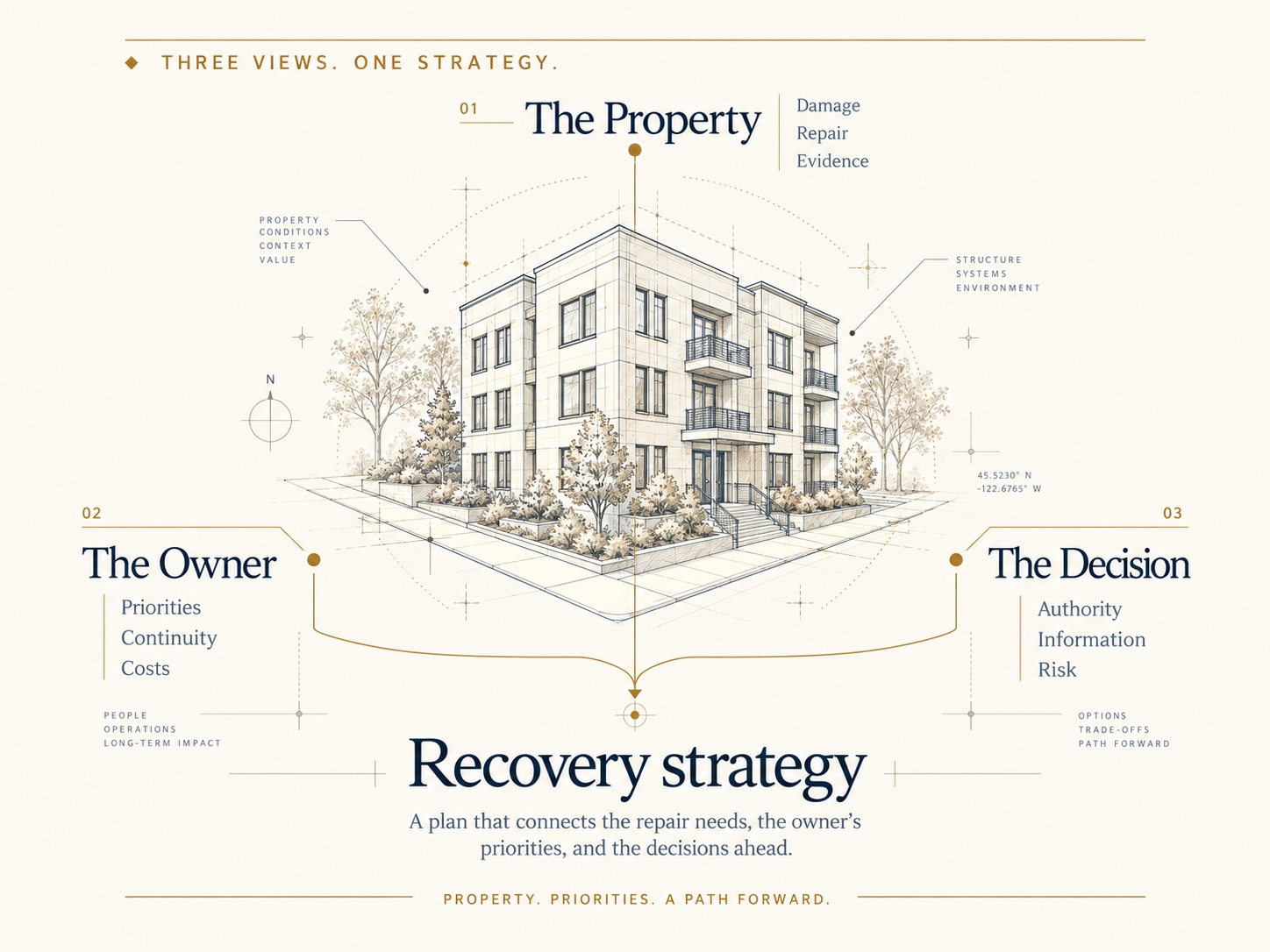
Three views. One strategy.
The approach in practice
Every result below reflects this approach: connect the property evidence, the owner’s priorities, and the decisions that can move the matter forward. The work takes a different form in each case.
Explore all case resultsCommercial construction
Apartment-building defects, delays, and lost rents.
Connected construction defects and repair costs to delay impacts and the owner’s financial losses.
Read the resultHomeowner insurance
A winter-weather claim and the full consequences of the loss.
Challenged the repair scope and accounted for loss of use, contents, code upgrades, and other damages.
Read the resultCondominium construction
Building-wide siding and window repairs for a 12-unit condominium.
Built the defect proof and secured a complete repair program with owner-side oversight.
Read the resultCommercial insurance
A Portland strip-center water loss and insurance shortfall.
Brought policy language, repair pricing, code upgrades, and loss-of-rent evidence into the claim.
Read the resultHomeowner insurance
Denied coverage after the January 2024 storm; the case went to trial.
Pursued several strategic avenues at the same time, creating multiple pressure points on the insurer.
Read the resultHidden defects & inspection
Foundation issues following a defective home inspection.
Evaluated responsibility and focused on the home inspector and its insurer as the stronger recovery path.
Read the resultRepresentative results are examples only. Every matter depends on its own facts, evidence, timing, contracts, policies, parties, defenses, damages, and applicable law. Past results do not guarantee future outcomes.
The multidisciplinary advantage
The needs of the matter determine which outside perspectives or specialists to involve. Each contributes to a clearer understanding of the property and the choices ahead.
The foundation
The firm directs legal strategy. Industry advice informs the work; responsibility for legal judgment remains with the firm.
Kelly McCann’s experience as a construction estimator and superintendent brings a practical understanding of repair scope, sequencing, and cost.
Meet Kelly McCann and the teamWho can change the position—and what do they need to see?
Examine how claims are evaluated, where information sits, who has payment authority, and what evidence could change the analysis.
What does proper repair actually require?
Test causation, repair methods, scope, sequencing, and costs against the actual condition of the property.
What will the board and community need to decide?
Account for board responsibilities, owner communication, resident disruption, repair phasing, and reserve and assessment pressures.
How does the property keep functioning while the dispute moves forward?
Consider tenant needs, operating income, cash flow, financing, carrying costs, and repair timing alongside the dispute.
From analysis to action
Develop the evidence. Understand the choices. Assess each next step against the property’s needs and the owner’s priorities.
Investigate the damage, preserve evidence, and define the repair needs and loss. Understand the owner’s priorities and document household, community, or operating impacts alongside the physical condition.
What happened? What can we prove?
Identify who made the decision, who can change it, and what information, responsibilities, constraints, and risks shape the other side’s position.
Who can change the outcome?
Present supported evidence and a clear request to the people with authority. Evaluate proposed terms against the proof, risks, repair needs, timing, and owner’s priorities. Pursue resolution or the next appropriate legal step.
What should happen next?
The owner’s priorities
Homeowners
Durable repairs, temporary housing, everyday disruption, and the costs the household is carrying all help define what a workable resolution needs to address.
Associations
Repair planning must account for board decisions, owner communication, resident disruption, reserves, and assessment pressures. Those responsibilities shape the choices ahead.
Commercial owners
We consider restoration alongside tenant needs, business income, cash flow, financing, carrying costs, and sequencing—the practical consequences of when and how repairs happen.
Start with your property
Tell us what happened, what needs to be fixed, and what the disruption means for you. You do not need a complete file to begin.